
Affiliate disclosure: purchases made throught the link may pay the affiliate a commision at no extra cost to you. Thanks for helping keeping the site running. Informational in nature only, not financial advice.
Surprising fact: Nearly one in four popular bullion pieces on the market will fail retirement account checks because of purity or maker rules.
This guide defines what “IRA eligible” means in the U.S. and why that label matters before you buy for a retirement account. You will see two core checkpoints: the minimum 0.999 fine purity and production by an approved mint or refiner.
Not every shiny product qualifies, even if it looks like investment-grade bullion. We’ll show how to compare silver bars vs. coins for a retirement plan and where collectible pieces can create trouble.
Storage and custody rules matter as much as the metal itself. Holding metals at home or with the wrong custodian can void tax advantages.
Key Takeaways
- Look for 0.999 fine purity and a recognized manufacturer before buying.
- Not all rounds or graded collectibles qualify for a retirement plan.
- Approved storage and a proper custodian are essential to keep tax benefits.
- Ask dealers for mint documentation and serial numbers when applicable.
- Use simple verification steps with your custodian before finalizing a purchase.
Why investors add physical silver to an individual retirement account
Investors turn to tangible metals when they want a different kind of exposure than stocks or bonds.
Our Top Company Pick for 2026

Minimum Investment with Augusta Precious Metals is $50,000.
See Our Full 2026 Company ComparisonSilver’s role as both an industrial metal and a monetary asset
Silver serves two audiences: manufacturers and savers. Industrial demand drives real consumption for electronics, solar panels, and medicine.
At the same time, buyers treat the metal as a store of value when currencies wobble. Those two forces make price moves less like a bond and more like a hybrid market instrument.
How a silver IRA can diversify retirement savings beyond stocks and bonds
A physical holding inside an individual retirement account can complement equities and fixed income. It offers a different risk profile and can help reduce portfolio correlation during turmoil.
Key reasons investors add this sleeve:
- Dual demand from industry and investors supports unique price behavior.
- Potential resilience during inflation or currency stress.
- Used with gold to build a broader precious metals allocation.
- Practical concerns: spreads, liquidity, and careful product selection.
Note: Tax advantages depend on following IRS rules and proper custody. The next sections explain those steps.
How a precious metals IRA works in the United States
The typical route for holding precious metals in a retirement account is a self-directed account that lets you own physical bullion and other metals. Self-directed means you control what investments the account holds, while a custodian handles paperwork and compliance.
What “self-directed IRA” means for precious metal investments
A self-directed retirement vehicle lets you add precious metals alongside stocks or bonds. The account owner chooses purchases, but a qualified custodian completes transactions and maintains records.
Who does what:
- Custodian: Holds the account, executes transfers, and files tax paperwork.
- Dealer: Sells the metals and provides assay or mint documentation.
- Depository: Provides third-party, IRS-approved storage for physical holdings.
Top precious metals companies of 2026
A side-by-side comparison of leading precious metals providers for physical metals and IRA rollovers.
Why IRS-approved storage is required for bullion
The IRS requires approved, third-party storage so the metal isn’t treated as a personal distribution. Home storage or personal possession can trigger taxes and penalties.
Traditional accounts are generally tax-deferred; qualified withdrawals from a Roth are typically tax-free. That timing difference helps you decide which account fits your goals.
Bottom line: The tax benefits exist only if custody and storage rules are followed. Next, we’ll cover what makes a bar or coin the right product for an account, not just the right metal.
IRA eligible silver bars requirements
Buying bullion for an account means checking both the metal’s fineness and the maker’s credentials.


Minimum purity rule
Minimum purity: Most IRA approved bullion must meet at least 99.9% fineness (0.999). This is a clear cutoff: anything below that normally fails the test.
Who makes the metal matters
Mints and accredited refiners must produce the product. The same purity can still be disqualified if the maker is unknown or unaccredited.
Common failures and what to watch for
- Unknown or small-pour producers without industry accreditation.
- Items marketed as collectibles or altered products rather than standard bullion types.
- Missing markings or unclear weight and fineness stamps.
Markings and condition
Look for weight in troy ounces, purity (0.999 or 0.9999), and a recognizable maker hallmark.
Condition can matter: coins usually must be uncirculated and undamaged, while some proof or graded pieces need original packaging and certificates.
Final step: Ask your custodian to confirm their compliance checklist before funds move. Once you know the rules, you can shop by refiner reputation and product format with confidence.
Which silver bars typically qualify for a silver IRA
Reputable manufacturers and recognized delivery formats guide most investors toward compliant physical holdings.
Common names you’ll see on lists include Royal Canadian Mint (RCM), Sunshine Mint, Engelhard, Nadir, Johnson Matthey, Valcambi, Credit Suisse, PAMP Suisse, Perth Mint, and Asahi.
Why these mints matter
Trusted makers offer clear stamps, assay records, and known chain-of-custody, which helps custodians and depositories accept the product.
What exchange-accredited signals mean
Exchange accreditation usually signals consistent assay standards and easier resale. It shows the market that a product meets trading and custody norms.
Sizes, formats, and large-format options
Common weights are 1 oz, 10 oz, and 100 oz. Larger bars often cut per-ounce premiums, while good delivery and 1,000 oz formats suit bigger allocations.
“Buy the documentation as much as the metal — proven provenance matters.”
Remember: brand recognition helps, but compliance rests on meeting stated fineness and sourcing from certified producers. Next, we’ll cover how “Any Mint, Any Condition” formats can still fit the rulebook if verified.
Our Top Company Pick for 2026
Minimum Investment with Augusta Precious Metals is $50,000.
See Our Full 2026 Company Comparison“Any Mint, Any Condition” silver bars and what to verify before buying
Some investors buy mixed-brand, mixed-condition silver to save on premiums while still stacking ounces. In plain terms, Any Mint, Any Condition means you pay for weight, not polish or brand cachet.
These pooled products can lower costs for investors who value ounces over presentation. Lower premiums come from accepting varied finishes, minor scratches, or mixed producers in one shipment.
Still, non-negotiables remain. Each piece must show weight and fineness, and it should come from known refiners or approved mints. Even discounted products must meet the same purity and marking standards as branded products.
- Ask which mints or refiners are in the pool and request a list of producers.
- Confirm how dealers authenticate and document each item before transfer.
- Have your custodian verify that the products are ira approved for your account before purchase.
Warning: “Any mint” should never mean “unknown mint.” Unknown producers can block acceptance and create compliance issues for retirement investments.
“Buy the documentation as much as the metal — provenance matters.”
Many buyers pair pooled bars with well-known coins to boost liquidity and resale options. For a simple next step, learn how to buy silver for your ira and combine both product types.
Popular IRA-approved silver coins that can complement silver bars
Many investors pair well-known coins with bars to balance liquidity and recognizability.
Why add coins? Coins offer easy resale in small lots and clear anti-counterfeit features. That makes them useful for building a flexible position alongside larger pieces.
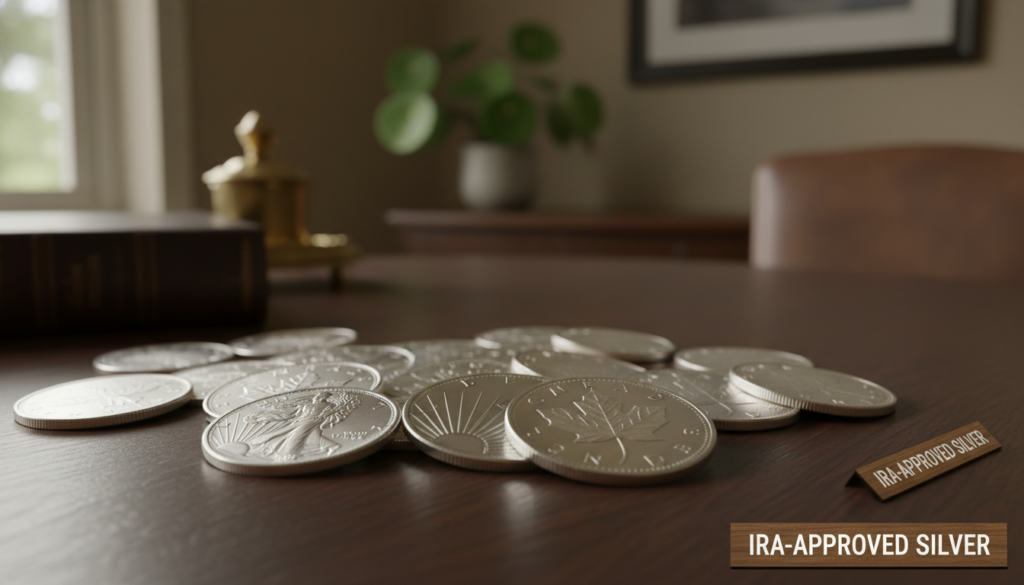

American Silver Eagle as a go-to option
The American Silver Eagle is widely recognized and liquid in U.S. markets. Buyers often source them in bulk—monster boxes of 500 are common for scale.
Note: Some proof versions are sought after, but confirm acceptance with your custodian before buying.
Canadian Silver Maple Leaf from the Royal Canadian Mint
The Silver Maple Leaf is 99.99% pure and made by the Royal Canadian Mint. That high fineness and modern security features make authentication straightforward.
British Silver Britannia: watch the year
Britannia coins meet current fineness standards only from 2013 onward. Earlier issues were lower purity and can cause compliance issues.
- Quick compare vs. gold: Coins usually give lower entry cost per unit, while gold remains the choice for high value density.
“Choose recognized coin issues to simplify resale and verification.”
Next: Not all products that look like bullion qualify for retirement accounts. The following section explains common pitfalls and disqualified items.
Silver products that are not IRA eligible and common pitfalls
Understanding which products fail the screening helps you avoid costly tax mistakes. Below are common problem types and what to watch for before you buy for a retirement account.
Why “junk silver” usually fails
Junk silver refers to older circulating coins, often U.S. coinage minted before 1965. Those coins are typically 90% pure and do not meet the minimum purity needed for account acceptance.
Rounds and hand-poured pieces
Some rounds look like bullion but come from small, unaccredited makers. If the producer lacks recognized assay records, custodians may refuse the product.
Hand-poured items pose similar risks. They vary in fineness and lack consistent provenance, which makes authentication hard for depositories.
Collectible and graded coin issues
Rare coins, graded slabs, and high-numismatic pieces shift focus from metal content to collectibility. Graded or proof coins often require original packaging and certification to be considered acceptable.
“When in doubt, treat unfamiliar products as non-eligible until your custodian confirms in writing.”
Buying the wrong type can trigger compliance problems and jeopardize the tax treatment of your precious metal holdings. Next, learn how proper storage and custodian steps protect even eligible pieces.
Storage, custody, and compliance essentials for IRA-approved precious metals
Storing retirement metals correctly protects your account’s tax status and avoids costly mistakes.
Why home storage risks your retirement plan
Keeping precious metals at home can trigger a distribution event. The IRS treats personal possession as an early withdrawal in many cases.
That means possible taxes and penalties, and loss of the intended tax advantages tied to the account.
How custodians, dealers, and depositories work together
The process uses three parties: a custodian manages the account and paperwork, a dealer sources the product, and an approved depository holds the metals.
Shipments should go directly to the depository, not to the investor, to preserve compliance and insurance.
What you should keep for records:
- Trade confirmations and invoices
- Product specs and mint documentation
- Custodian statements and depository receipts
Storage and insurance are part of the fee structure. Treat that cost as part of long-term retirement planning.
The same custody rules apply whether you later add silver or other metals to the account, so keep procedures consistent.
“Route shipments to the depository and keep clear records to protect your tax treatment.”
Our Top Company Pick for 2026

Minimum Investment with Augusta Precious Metals is $50,000.
See Our Full 2026 Company Comparison
Choosing the right silver products by budget, premiums, and liquidity
Deciding between coins and larger bars starts with how much you plan to invest today.
How premiums work: The market price is the spot price; the premium is what you pay above spot for minting, distribution, and dealer margin. Generally, bars cost less per ounce than coins at the same spot level, so you get more metal for the same budget.
When larger pieces may be the better value
Bars win on cost-per-ounce for big allocations. Choose them when you want maximum ounces and lower ongoing premiums. The tradeoff is unit size — large pieces are harder to sell in small chunks.
Monster boxes and scaling coin positions
Monster boxes (commonly 500 American Silver Eagle coins) cut per-coin premiums and simplify bulk buying inside a retirement account. Sealed bulk packaging can improve liquidity and speed resale when markets move.
Good delivery for large allocations
Good delivery bars are exchange-accepted formats that offer the lowest per-ounce premiums but require larger capital. For balance, many investors pair these holdings with coins for flexible resale and with gold or platinum for portfolio diversity.
“Think ahead: pick products that fit your buy-in size and your exit plan.”
Conclusion
,Keep three core rules in mind when adding physical metals to an individual retirement plan.
Purity, clear sourcing, and approved custody form the foundation. Meet the minimum fineness, buy from known refiners or mints, and route shipments to an IRS-approved depository to protect tax status. This approach makes a silver ira a straightforward way to add tangible holdings to retirement savings.
Start with recognized coins and reputable bars from established refiners. Pair coin liquidity with bar value or monster boxes for scale. Avoid junk silver, unknown hand-poured rounds, and collectible or graded pieces unless your custodian confirms acceptance.
Match product choice to goals—lower premiums, easier resale, or bulk ounces—and always confirm eligibility with your custodian before purchase. That one step protects your individual retirement account and future outcomes.