
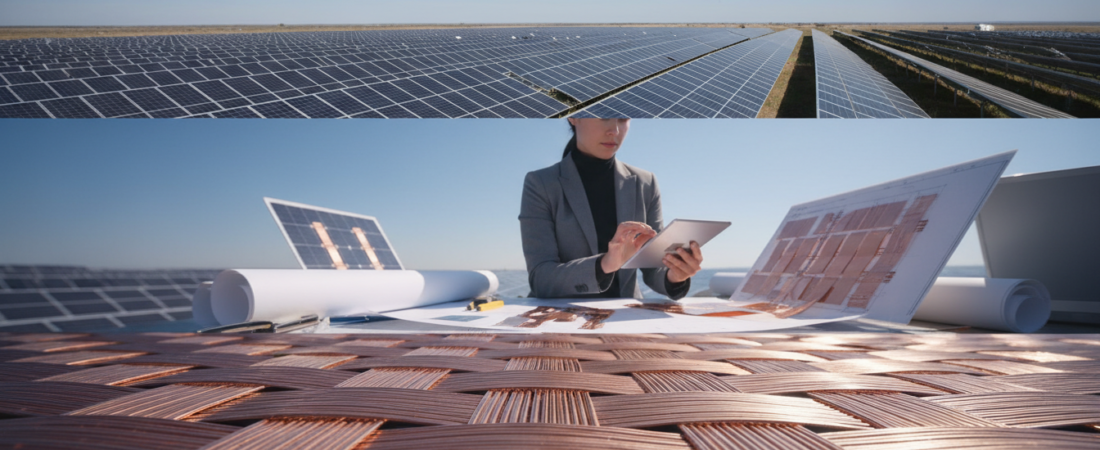
Surprising fact: more than 40% of recent module cost concerns trace back to a surge in contact metal price and supply worries, sparking a new news cycle about metals on the roof.
This piece sets the scene for U.S. buyers, installers, and manufacturers who ask whether copper can step into a role long held by silver.
Here the term “replace” means changing the tiny metal contacts that carry current, not redesigning the cell itself. Silver has high performance but now faces supply pressure and higher market cost.
Engineers and vendors are testing copper and new electroplating methods on pilot lines. The core tension is clear: performance and reliability versus lower commodity price and scale.
We preview drivers—rising commodity costs, rapid PV scaling, and lab-to-factory process moves—and promise a balanced look at what the shift could mean for module cost and U.S. project economics.
Key Takeaways
- High silver cost and supply risks are pushing the industry to explore alternatives.
- “Replacement” mainly targets metallization for cell contacts, not the whole module.
- New plating processes aim to scale copper use from lab to pilot lines.
- Reliability tests remain the gating factor for banks and EPCs.
- Any shift could lower upfront module cost but will affect supply chains and long-term pricing.
Why this solar materials shift is making headlines now
Rapid clean-energy builds have pushed metal demand onto front pages and balance sheets, turning industry updates into national news.
Metal‑intensive growth and the scramble for critical materials
Wind, EVs, storage, and rooftop projects all need wiring, contacts, and conductors. That rising demand stresses global production and the chain that feeds it.
As more projects come online, the conversation shifts from “can we build enough?” to “can we build without hitting supply limits or steep price jumps?” This matters for anyone financing or installing systems.
What the cost debate means for modules and electricity
The current storyline is a straight cost-and-availability tradeoff. A change in contact metals affects module manufacturing costs, which flows through to the module price and then to the price consumers pay for energy or power.
Macro signals add urgency. The IEA flags copper demand rising sharply by 2040, and BHP notes ore grades and new-mine costs are trending the wrong way. Volatile prices and constrained supply mean even alternatives are not risk‑free.
Over the next few years, metals markets could steer manufacturing scale-up as much as efficiency gains. The rest of this article shows what is proven, what’s on pilot lines, and what remains uncertain for U.S. adoption.
What silver does inside a solar cell and why it’s hard to replace
At the cell level, tiny metal lines collect and move charge. On modern solar cells a thin network of printed traces and busbars gathers current from the wafer surface and guides it out to the module junction.
Contacts, busbars, and conductivity
The printed contact is where generated electrons leave the device. Good conductivity and low contact resistance keep losses tiny but meaningful across many cells.
Even small extra resistance at each contact reduces module output over the system lifetime. That’s why contact design, adhesion, and corrosion behavior matter so much for long-term yield.
How metal use shows up in module cost
Proven performance and mature screen-printing chains made this metal the default for contacts and busbars. Banks and EPCs trust decades of field data when sizing risk.
- Fraunhofer ISE notes that the metal’s use can account for roughly ~10% of manufacturing cost for a photovoltaic module.
- That dollars-and-cents effect drives efforts to cut content or find alternatives.
Changing contact materials is not a simple swap. Adhesion, passivation layers, and corrosion risks affect real-world output and warranty assumptions. The next section looks at market forces that are accelerating the search for other options.
Silver supply, demand, and price pressures reshaping solar economics
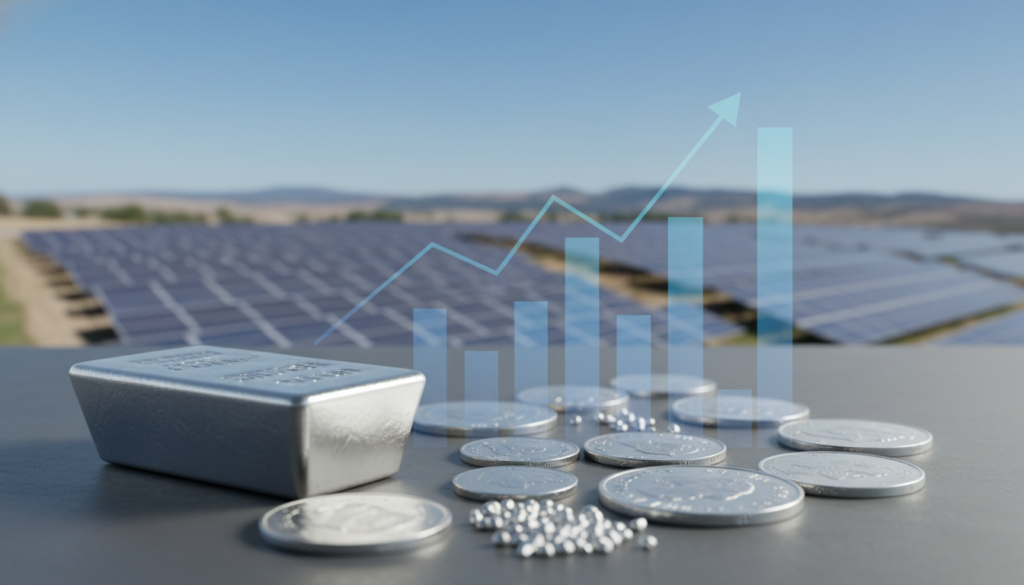
Since 2015, demand for PV contact metal has jumped from under 60 million ounces to nearly 200 million ounces. Total annual production has held near one billion ounces, creating recurring deficits that began around 2019.
Growing deficits and the price signal
Persistent shortfalls push prices higher and make costs volatile. The headline move from about $16/oz in 2019 to over $38/oz today matters when a tiny metal line is used across billions of cells.
Intensity gains can’t always beat scale
ITRPV forecasts show silver intensity per watt falling — roughly from 12 mg to 8 mg by 2035. That helps. But if annual PV installs climb fast, total demand still rises.
- At 448 GW/yr, demand could ease to ~133M oz by 2035.
- At ~24% CAGR, demand may hit ~383M oz by 2029 and exceed global supply by 2035.
For U.S. developers and manufacturers, higher and volatile prices alter module cost and project economics even when per‑watt metal use drops. Planning must account for both intensity trends and rapid growth scenarios.
Will copper replace silver in solar panels
The short answer: lower-cost conductors may handle contact duties, yet industry adoption hinges on durability and process readiness.
What this change actually means: the issue targets tiny printed or plated traces on a cell, not silicon wafers, glass, or module architecture. Swapping contact metal affects only metallization and busbars.
Why the alternative is attractive: copper is far cheaper per unit and more abundant than silver, so it can lower material cost on high-volume lines and ease price pressure for manufacturers.
How engineers are pursuing that gain: the main pathway is electroplating and plating-friendly inks that aim to match conductivity and adhesion while avoiding corrosion failure.
“Proof of long-term reliability — not raw price — will decide whether new contacts gain bankability.”
Adoption timing depends on accelerated stress tests, warranty acceptance, and factory process changes. The next section dives into the electroplating advances that make this path credible today.
The technology behind copper contacts: electroplating moves toward prime time
Electroplating deposits metal onto defined contact areas rather than printing a thick paste. This lets manufacturers form very thin, highly conductive tracks that keep series resistance low.
Fraunhofer ISE targeted heterojunction cells because their passivation and front-side design match plating needs. That makes the approach attractive for high-efficiency cell development and future production lines.
Laser structuring and ultra-thin lines
Laser patterning lets lines shrink. Fraunhofer reported ~19 μm conductor widths, which cut shading on active silicon.
How less shading improves electricity yield
Narrower traces expose more cell surface to light. Higher light capture lifts module yield, helping offset any worry that cheaper materials harm performance.
Why the full package matters
The win comes from combining laser patterning, plating chemistry, and passivation compatibility. Researchers stress that plating uniformity and line adhesion are as important as raw conductivity.
| Feature | Benefit | Scale-up challenge |
|---|---|---|
| Electroplating process | Thin, low-resistance contacts | Uniform deposition at high throughput |
| Laser structuring (~19 μm) | Reduced shading, better light capture | Precise alignment and cycle time |
| Heterojunction focus | Compatibility with advanced passivation | Integration with existing cell lines |
Beyond silver-to-copper: replacing polymers with recyclable aluminum masking
Before any plating begins, manufacturers must shield non-target areas so metal only lands where intended.
Why masking matters: plating deposits metal onto exposed contact lines. A masking barrier prevents unwanted deposition and protects passivation. Without a reliable mask, cells suffer shorts, defects, and yield loss.
Today many lines use polymer lacquers or laminated foils. Those polymer masks create leftover waste and add disposal costs. That waste stream is an unglamorous but real burden for production.
Fraunhofer ISE developed an alternative: recyclable aluminum masking. Although aluminum conducts, its surface forms a thin insulating oxide that blocks deposition. Proper oxide control and adhesion let the aluminum act as a temporary barrier during the plating process.
The double win: pairing a move from silver to copper with polymer→aluminum masking can cut material costs, lower waste, and improve circularity. Gains depend on cleaning, oxide management, and repeatable adhesion during high-throughput runs.
“Aluminum masking shifts a disposals problem toward a recyclable loop, but manufacturing details decide broad industry adoption.”

From lab to market: pilots, spin-offs, and funded projects to watch
Pilot lines turn lab promises into real production data that banks and buyers can trust. Pilots test throughput, yield, and consistency so a high-efficiency cell isn’t just a one-off result.
PV2+ and the push toward pilot production
Fraunhofer ISE launched PV2+, led by CEO Dr. Markus Glatthaar, to speed commercialization. Researchers there aim to partner with industry to move electroplating know‑how onto factory floors. The spin‑off targeted pilot production in early 2023 and won BMWK EXIST backing to accelerate development.
CuSun: funded collaboration that ties lab work to industry
The CuSun project secured about 10.063.238 DKK from EUDP. Partners include Aarhus University, IPU, and Elplatek. This project blends PV physics, plating expertise, and industrial partners to mature product readiness for mass production.
What accelerated stress testing must prove
Stress tests simulate years of field exposure in much less time. They hunt for degradation modes and show whether cells maintain electricity output and predictable decline. Lenders look for stable performance, repeatable manufacturing, and clear degradation models before signing off on volume production.
“Scale-up proof means repeatable yield, known failure modes, and data third parties trust.”
Performance and reliability questions that still need answers
Long-term field data, not lab slides, decide whether a contact change earns trust. Developers, banks, and insurers demand multi-year proof that new approaches keep output and warranties intact.
Contact passivation, degradation modes, and long-term field stresses
Key open questions include long-term reliability, corrosion behavior, and adhesion stability. These challenges shape whether a new contact holds up over time.
Degradation modes cover thermal cycling, humidity, UV exposure, and electrical stress. Each can raise resistance or create hot spots that cut electricity yield.
Efficiency comparisons across cell technologies
Early pilots show promise across heterojunction and TOPCon technologies. But different technologies pose unique challenges for passivation and processing.
Reality check: even strong lab efficiency needs matching lifetime data. Lenders want repeatable stress tests and climate-varied models before they underwrite volume projects.
“Proof across climates and time is the single most important barrier to broad adoption.”
Next: even with technical success, market impact depends on supply chains and resource constraints that shape cost and scale.
Costs, supply chains, and market impact: silver, copper, and the next bottleneck
Global metal flows now shape whether modules stay affordable as deployment climbs. This section looks at how tight markets and shifting demand affect factory budgets and project planning.
Why deficits matter even as per‑watt use falls
Silver demand for contacts rose sharply and total supply has run near ~1B oz/yr since 2015, with deficits near ~200M oz after 2019. Lower grams per watt help, but fast production growth can keep total need high.
IEA and BHP warnings on looming mine gaps
The IEA projects demand rising from ~26,717 kt (2024) to ~34,137 kt by 2040, creating a >10,000 kt/yr mine gap. BHP flags declining ore grades and big jumps in new‑mine capital costs, so raw material price risk is real.
How volatility feeds through to modules and power systems
Volatile copper markets — with peaks above ~$5.50/lb since 2020 — matter because this metal also appears in wiring, inverters, and grid work. Sudden swings raise budget uncertainty for manufacturers and developers.
A metal shift inside the cell can cut module bills, but total system cost still depends on broader electrification demand for modules and for power infrastructure.
“Substitution can reduce exposure to silver spikes, yet it may raise sensitivity to copper cycles unless recycling and new supply scale fast.”
Measured outlook: substitution eases one pinch point, but the industry faces a moving bottleneck. Effective risk management needs diversification, long‑term contracts, and stronger recycling loops to steady prices and protect project returns.
What this could mean for the US solar industry over the next few years
For U.S. developers, material swaps translate directly into procurement risk and long‑term project returns.
Module pricing and procurement: Near‑term module price relief is possible as input costs fall. That can ease budgets for utility‑scale and C&I projects and improve bid competitiveness. Yet buyers must weigh short‑term savings against warranty terms and field data.
Domestic production and factory impact: Adopting new contact processes may require new equipment, updated QA/QC protocols, and some line retrofits. Some existing lines can adapt; others need redesign to meet throughput and reliability targets.
Bankability and finance: Lenders will demand third‑party reliability data, clear warranty language, and degradation models before shifting acceptance. Proven stress tests and early U.S. case studies are crucial.
Effect on LCOE: Lower input costs can cut capex and reduce levelized cost of energy, but gains appear only if uptime and degradation stay within forecasted levels.
- Two‑way risk: Reducing exposure to one metal eases some price swings while exposing projects to other market cycles.
- What to watch: pilot results, UL/IEC disclosures, warranty updates, and early U.S. field reports.
Conclusion
Key takeaway, the most credible path to ease contact‑metal pressure is through advanced electroplating and plating-fed production changes rather than a full cell redesign.
The practical meaning of any move is focused: teams aim to replace silver contacts on the front of the cell, not reinvent wafers or module architecture. That narrower scope keeps testing and scale-up manageable.
Market forces—ongoing deficits and price pressure—plus real R&D progress from groups like Fraunhofer ISE and funded projects such as CuSun drive this development. Early pilots show promise but stop short of proof.
Adoption hinges on bankable durability. Lenders and buyers need long-term field data that shows new products survive thermal, humidity, and electrical stress without unacceptable loss.
For U.S. readers, if pilots validate performance at scale, plated metallization could become a practical lever for cost control and supply‑chain resilience in the next wave of growth.